


There are a lot of moving aspects in the world of construction project management. To keep track of finances, schedules, materials, and teams, you need to always be on the lookout and have access to reliable information. For a long time, the industry used spreadsheets for manual reporting. However, this approach is often slow, unreliable, and doesn't always give a whole picture of how well a project is doing. Microsoft Power BI is a powerful option that turns data into clear, useful insights. Using Power BI, construction companies can stop reacting to problems and start managing projects proactively with more clarity and control than ever before.
Adding Power BI to your work process might completely change the way you handle projects. It combines data from several sources, like accounting software, project scheduling tools, and reports from the field, into dashboards that are easy to use and understand. This lets managers see every part of an operation in real time and from all angles.
Let's look at five important ways that Power BI is changing the construction business-
1. Tracking and visualizing data in real time
Getting timely updates from the field to the office is one of the hardest things about construction. If data entry takes too long, the information in a report may be out of date by the time the project manager reads it. This delay might cause people to make bad decisions based on obsolete data, which can lead to budget overruns and schedule slips.
Power BI gets rid of this latency by connecting directly to your data sources and giving you updates in real time. Think of a dashboard that shows you how a project is doing, keeps track of how much equipment is being used, and keeps an eye on the hours worked as they are logged. You don't have to wait for weekly reports to know what's going on at the site at any time.
Some of the most important benefits are:
- Dashboards in real time: Keep an eye on key performance indicators (KPIs) including schedule variance, cost performance index (CPI), and safety problems as they happen.
- Mobile Access: Project managers can get important information on a tablet or smartphone while strolling around the project site, which lets them talk to foremen and subcontractors right away and make decisions based on that information.
- Personalized Alerts: Set up automatic notifications for when specific metrics go outside of permissible ranges. For example, if a project is behind time or a budget line item is getting close to its maximum.
This rapid access to information gives teams the power to find and fix problems before they get worse, keeping projects on track and stakeholders up to date.
2. Improved team communication & collaboration
Good communication is the most important part of managing a project well. Plans that are well thought out can easily go wrong if teams aren't on the same page, stakeholders aren't kept up to date, and reporting isn't clear. Power BI provides a solution where everyone, from the executive team to the on-site personnel, can get the same information.
Impressively, within Power BI, you can assign distinct groups of people specific information by making dashboards for each role. Executives can see a high-level overview of the portfolio, while project managers can look at the details of a single project. Subcontractors can see dashboards that are connected to the job they are on, making things more open and accountable.
This common knowledge makes it easier to work together. Meetings are more effective when everyone can see the same data in a clear and visible way. Teams can spend less time arguing over whose numbers are right and more time working together to find solutions. This alignment makes sure that everyone knows how their choices will affect the project as a whole.
3. Using predictive analytics to manage risk before it happens
Building things is dangerous by nature. Things like unexpected site conditions, problems with the supply chain, and not enough workers can all affect how a project turns out. In traditional project management, people usually wait until problems happen before they do anything about them. But Power BI lets you take a more proactive approach with predictive analytics.
Power BI helps find trends and patterns in past project data that could mean future dangers. For instance, it can look at historical projects to see how likely it is that delays would happen based on the time of year, certain subcontractors, or types of materials. This lets project manager see possible problems ahead of time and come up with plans to deal with them.
Predictive talents can help with:
-
Predicting when things will be done: Look at the present progress rates and the work that still needs to be done to make more accurate predictions about the project timeline.
-
Finding At-Risk Tasks: Find the tasks on the critical path that are most likely to be delayed.
-
Optimizing Resource Allocation: Use project phasing and past usage patterns to guess what resources will be needed in the future. This helps to avoid shortages or over-allocation.
Construction companies can greatly lower project risks and make their outcomes more definite by changing their way of thinking from reactive to predictive.
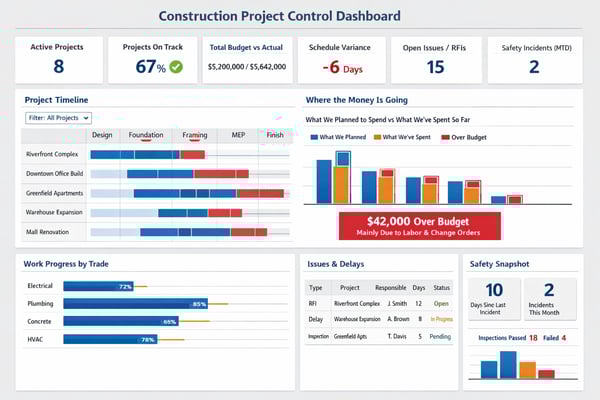
4. Better financial control and cost management
Controlling expenses is very important for making money in construction. Tracking expenses, purchase orders, and change orders by hand across several systems takes a lot of time and can lead to expensive mistakes. Power BI brings together all of the financial information so you can see the whole picture of a project's finances.
Project managers may see how much money they are actually spending compared to the budget in real time with a financial dashboard. They can look at individual cost codes to see where the money is going and find any differences right away. This level of information makes it easier to keep an eye on expenditure and helps keep budgets from going over.
Power BI also makes it easy to handle change orders. Seeing how a suggested change would affect the cost and schedule helps everyone involved make better choices. When you combine financial data with project timelines, you can clearly show how a change will influence the bottom line and the completion date. This makes negotiations and approvals more open.
5. Making decisions based on data
The main purpose of every business intelligence product is to help people make better choices. Managers in construction are always having to make important decisions that affect safety, quality, schedule, and cost. If you rely on your gut feeling or incomplete evidence, your project may fall short.
Power BI gives you the concrete facts you need to make decisions that are based on evidence. Should you let someone work extra hours to finish a task that is behind schedule? You can see the cost effect versus the scheduling benefit on a Power BI dashboard. Is a subcontractor not doing a good job? You can dig out their performance stats from a number of projects to back up your point.
This habit of using data goes beyond just one project. By putting together data from all of the portfolio's projects, management can see how well the whole firm is doing. They can tell which kinds of projects make the most money, which project managers do the best job, and where there are problems with the system. These insights are very helpful for making long-term business plans and growing the company.
Power BI as a real world application
Companies like Nucor have already seen the benefits of this approach. By developing custom weekly reports, they successfully streamlined their project oversight. You can see how this strategy works in practice in our Nucor CASTRIP case study. These insights are very helpful for making long-term business plans and growing the company.
The construction industry is changing, and the companies who utilize technology to the fullest will be the ones that succeed greater than their competition. Microsoft Power BI is more than simply a tool for making reports; it is a full solution for updating how construction projects are managed. Power BI gives construction organizations the tools they need to build more efficiently, profitably, and with more confidence. It does this by showing data in real time, encouraging collaboration, allowing predictive analytics, tightening cost controls, and supporting decisions based on data. Using this technology lets you turn raw data into your most valuable asset, changing the way you manage projects from start to finish.
Interested in learning more about how Power Bi can help your business? We'd be happy to help!


